Research
Our laboratory conducts research to realize resilient buildings and cities against disasters such as fires. Here, we introduce some of our recent research projects.
Research on Disaster Prevention Planning for Buildings and Cities Using a Computational Science Approach
The nature of disasters occurring in buildings and cities is strongly influenced by the social structure of the time. A clear example is the change accompanying the declining birthrate, aging population, or population decline. If the number of inadequately managed vacant houses increases due to population decline, the impact of a disaster will become more pronounced. Furthermore, a decrease in the working-age population reduces the disaster response capacity traditionally and implicitly borne by local communities. When the social structure changes, buildings and cities should ideally undergo corresponding changes, but this is not easy as the physical renewal of urban spaces requires a long time. In this research, we focus on the discrepancy between the "speed of social change" and the "speed of spatial renewal." We quantitatively evaluate and predict the disaster risks amplified by this discrepancy using a computational science approach, and investigate disaster prevention measures adapted to future social structures.
Development of Risk-based Fire Safety Design Method for Timber Buildings
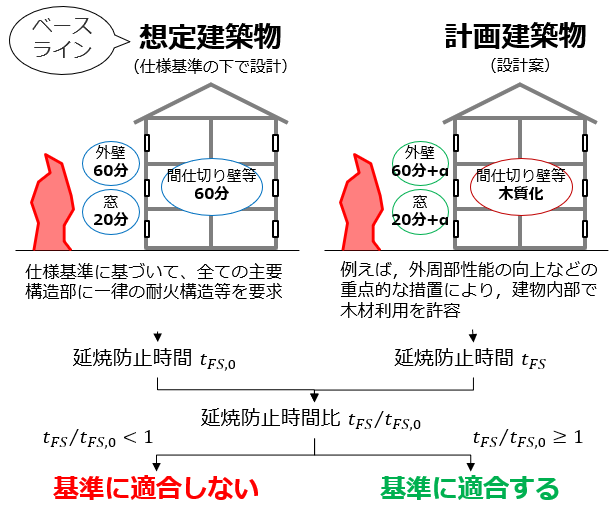
In fire safety design of buildings, compliance is generally verified by confirming safety under specific fire scenarios using deterministic methods. However, actual fire situations are influenced by various conditions that cannot be fully covered by a single scenario, necessitating large safety margins. This is particularly true for timber buildings, where discussions have been insufficient due to reliance on prescriptive codes. We are working on developing a risk-based fire safety design method that considers the impact of various uncertain factors affecting fire safety performance, aiming to rationalize fire safety design.
References
- Himoto K. A risk-based design method for preventing fire spread between buildings to achieve a safety level equivalent to the prescriptive standard, Fire Safety Journal, Volume 162, 104749, 2026
- Chatani, Himoto, et al.: Verification of Fire Spread Prevention Performance of Buildings with Wood Interior Structure - Case Study on Office Buildings, AIJ Journal of Technology and Design, Vol. 26, No. 63, pp.591-596, 2020 (in Japanese)
- Himoto, Itoigawa, Iwami: Verification of Fire Spread Prevention Performance of Buildings Based on Relative Risk, Journal of Structural and Construction Engineering (Transactions of AIJ), Vol. 84, No. 764, pp.883-891, 2019 (in Japanese)
Development of Method for Assessing Functional Maintenance Performance of Fire-Damaged Buildings
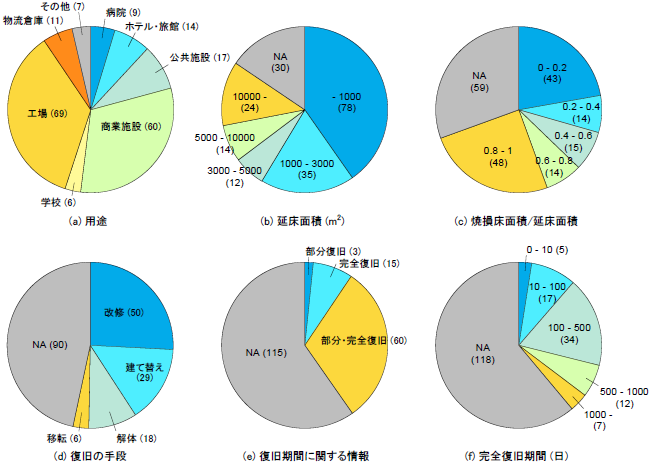
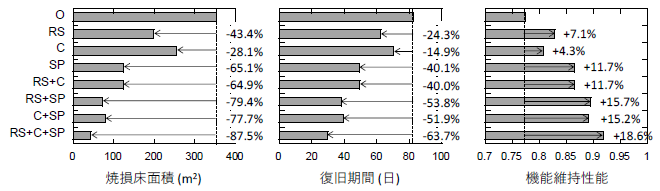
Requirements of the Building Standards Act are limited to minimum levels deemed necessary for life safety. Consequently, even compliant buildings may suffer extensive damage in a fire, becoming unusable for long periods or requiring reconstruction. Conventional fire safety performance evaluation has focused on preventing direct damage such as collapse or ensuring evacuation safety, with little discussion on preventing functional degradation. We are developing a method to evaluate the functional maintenance performance of fire-damaged buildings by probabilistically describing the state transition of buildings.
References
- Himoto K, Sawada Y, Ohmiya Y. Quantifying fire resilience of buildings considering the impact of water damage accompanied by fire extinguishment, Reliability Engineering & System Safety, Volume 243, 109858, 2024
- Himoto K, Suzuki K. Computational framework for assessing the fire resilience of buildings using the multi-layer zone model, Reliability Engineering & System Safety, Volume 216, 108023, 2021
- Himoto K. Conceptual framework for quantifying fire resilience – A new perspective on fire safety performance of buildings, Fire Safety Journal, Volume 120, 103052, 2021
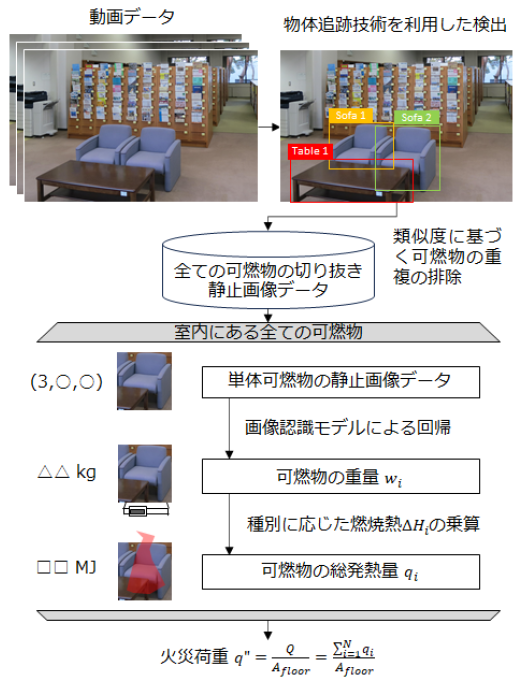
Development of Efficient Fire Load Survey Method Using Image Analysis Technology
In fire safety design, fire risk is evaluated based on fire load (weight of combustibles or total heat release per unit area). While fire load is set based on past survey results, actual conditions change with social situations. Therefore, expanding information and regular updates are necessary to maintain and improve the reliability of the fire safety design framework. We are developing an efficient fire load survey method utilizing image analysis technology based on deep learning.
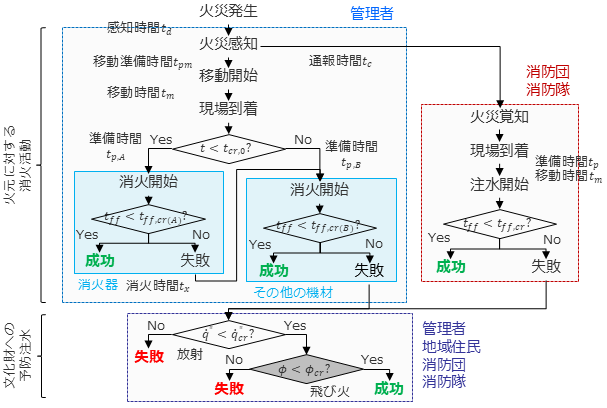
Development of Verification Method for Fire Management Systems of Historic Buildings Based on Fire Scenarios
To maintain the value of historic buildings, which are vulnerable to fire, for the future, a wide range of measures beyond those for general buildings is required. However, the content is often determined empirically, and there is no clear standard for sufficiency. We are developing procedures to verify the safety of historic buildings based on fire scenarios.

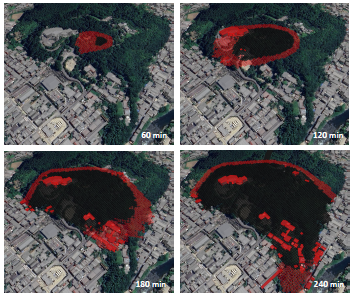
Development of Physics-based Fire Spread Simulation Model for Large Outdoor Fires at the Wildland-Urban Interface
The forest fire that occurred in Ofunato City in March 2025 engulfed many buildings and caused unprecedented damage. Quantitatively evaluating the risk of such large-scale outdoor fires is essential for considering future countermeasures. We are developing a physical simulation model to predict fire spread at the boundary by integrating models independently developed for urban fires and wildland fires.